
Searching Hancock County Civil Dockets
Hancock County has no public trial-court search portal. That shapes everything. For Circuit civil litigation, start with Circuit Court Clerk Micah Wallen. For divorce, parenting, probate, an estate, conservatorship, guardianship, trust, or equity work, start with Clerk and Master Judith H. Trent. The AOC lists that office at 1237 Main Street, Suite 104, P.O. Box 347, Sneedville. Ask which request methods the office allows: inspection, mail, fax, email, phone confirmation, or a counter visit. Some Chancery fax filing procedures are documented, though no universal electronic-copy policy exists.
Before you call, gather the court division, filing year, party names, case number, and a description of the document. Request the docket chronology plus the complaint, motion, order, decree, or judgment that matters. A docket line never reproduces the document. Need a certified copy? Say so up front and ask the current charge and accepted payment.
- Sort the case into Circuit, Chancery, General Sessions, appellate, or federal court.
- Write down the case number, year, names, and narrow date range.
- Contact the named clerk through an official county or AOC listing.
- Ask which inspection and copy channels apply to that file.
- Confirm cost, certification, mailing, and redaction before ordering.
Hancock Civil Circuit and Chancery Routes
One building houses Circuit, Criminal, and Chancery functions. Custody stays separate. Circuit Court handles general civil trials, jury and nonjury matters, statutory actions, and appeals from lower courts. Chancery covers equity plus much of Hancock County's domestic and probate work. General Sessions holds small civil matters within its statutory authority. A federal civil action naming a Hancock resident belongs to the Eastern District of Tennessee. It does not belong to any county civil docket.
| Case clue | Likely court | Record contact |
|---|---|---|
| Contract, damages, or lower-court appeal | Circuit Court | Circuit Court Clerk |
| Divorce, parenting, or child support | Chancery Court | Clerk and Master |
| Estate, probate, trust, or conservatorship | Chancery Court | Clerk and Master |
| Small civil statutory matter | General Sessions | Confirm with Circuit Clerk |
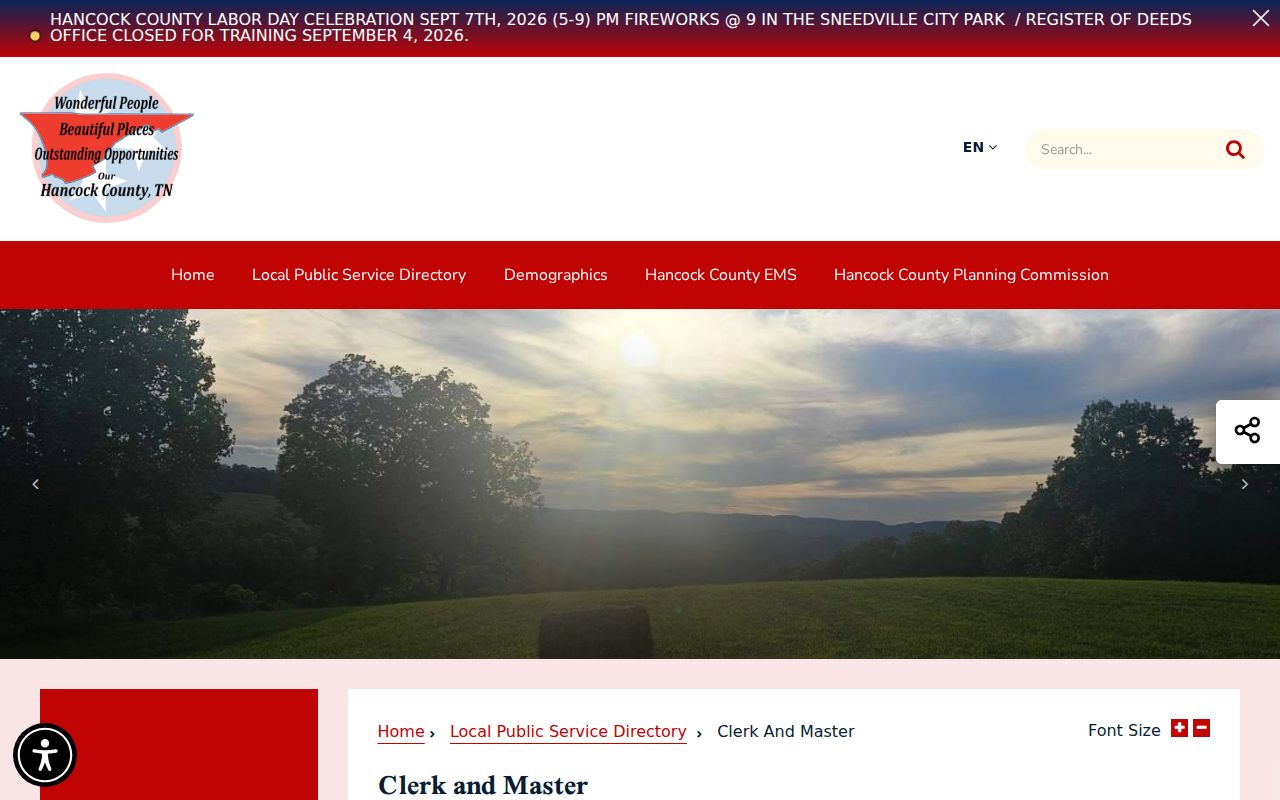
The official Clerk and Master page is the local starting point for the Chancery branch, listing office contact details straight from the county.
A local office listing beats a generic statewide search here. Hancock County does not take part in TnCIS, so a file held locally never surfaces on the state form.
Inside a Hancock County Civil Docket
A Hancock County civil docket records the sequence of a dispute or petition. Entries can include a complaint, petition, or service event. An answer, motion, hearing notice, continuance, order, decree, cost entry, and appeal can appear too. Chancery forms ask for a case number and a docket number. Use whichever identifier the clerk supplies. The AOC codes 34A1 and 34A2 mark reporting locations for Circuit and Chancery. Neither is a public case-number format.
| Case style | The caption or title; a filing allegation is not a proven fact. |
|---|---|
| Case or docket number | The clerk’s retrieval key, which may vary by division. |
| Filing and entry dates | Dates can differ from signature, receipt, or service dates. |
| Motion and setting | A request and its hearing date, not a final result. |
| Order or decree | The judge’s directive after it is signed and entered. |
| Costs and service | Separate entries for filing, copies, process, or later work. |
Read each event in sequence and request the paper behind it. An entry saying "order entered" confirms the event but not every term. "Continued" simply means the hearing moved. A dismissal can carry conditions. A final decree may hold protected data left off any public docket copy.
Hancock Civil E-Filing Is Not Search
Third Judicial District Chancery rules describe electronic filing through a clerk case-management system called TnCIS. Those rules cover filing, service, payment, signatures, redaction, electronic evidence, and system errors. The channel serves authorized users putting documents into a case. It is not a public Hancock County civil docket portal. The public TnCIS participating-office list leaves Hancock off it.
That gap trips up many searchers. A lawyer may have filed a Chancery document electronically. Even so, the public cannot pull the Hancock County docket through the statewide search form. For public access, contact the Clerk and Master and name the case and document. If TnCIS adds a Hancock office later, check the live list. Read the system terms first. For now the supported channels stay the same. The clerk counter, phone, mail, and the documented Chancery fax route remain available.
Hancock Civil Filings by Court
AOC Fiscal Year 2024 tables show why "civil docket" needs a court label. Hancock Circuit reported 12 filings. That count spans interstate support, an administrative appeal, contract, damages, a General Sessions or Juvenile appeal, and miscellaneous general civil matters. The same table records two dispositions. Hancock Chancery reported 71 filings and 54 dispositions. These are administrative events, not counts of people, households, money, or successful claims.
The Chancery mix was varied: 19 divorces without minor children, 18 probate or trust filings, nine divorces with minor children, six adoptions, five residential parenting or child-support matters, four real-estate matters, and smaller groups. Forty-five Chancery dispositions were reported as court-approved settlements. Those figures describe FY24 workload only. They say nothing about the merits of any family, estate, or property case.
Civil Case Types on the Docket
Circuit civil cases span several things. They cover contracts, damages, statutory appeals, jury or nonjury trials, and appeals from lower courts. Chancery brings its equity role, covering real estate, trusts, and other relief. It also handles local divorce, parenting, probate, estates, and fiduciary work. General Session may hold smaller civil matters. Getting the category right decides a lot. It sets the clerk, the index, the filing path, and the calendar you check.
- General civil claims, contracts, and damages in Circuit Court
- Divorce, parenting, and support matters in Chancery Court
- Probate, estate, trust, and annual-accounting files
- Guardianship and conservatorship proceedings
- Real-estate and other equity matters
Some Hancock County civil docket files hold child, medical, financial, or identifier data. The docket may be public while an attachment is not. Ask the clerk for a redacted copy when one exists, and remember that a missing document never means the case is absent from the court docket.
Hancock Civil Chancery Forms Map Filings
Hancock Chancery's agreed-divorce handout maps how filings turn into docket events. It requires a signed and notarized complaint. The packet also needs a marital dissolution agreement, a proposed final decree, a notice of hearing, a divorce certificate, and statistical information in a sealed envelope. When minors are involved, expect a parenting plan, child-support worksheets, and court-approved parenting classes. The waiting periods run 60 days without children and 90 days with them. Those numbers are procedural markers, though. They are not a promise of a decree on the first eligible day. The fax cover sheet maps a different route. It wants the case or docket number, document title, sender contact, date, and page count. The clerk logs processing and filing details. Payment is due with the cover within ten days. Anything over 50 pages needs preapproval. These forms open a filing channel, not a public search box. Before sending anything time-sensitive, confirm current rules with the Clerk and Master.
Civil Docket Settings and Hearings
Hancock Chancery runs its calendar a distinctive way. The dated calendar says the court holds no docket soundings. A party simply picks a listed date. Then the party sends a Notice of Hearing, or a letter, to the Clerk and Master. Jury trials and multi-day trials go through the Chancellor's office. They must be confirmed to the clerk. For a telephonic status conference, use the Chancellor's legal assistant. For a day-of-court telephone hearing, coordinate with the Clerk and Master. The posted dates covered 2024 and early 2025. Treat them as examples rather than a current 2026 schedule. A setting can still move after a continuance request. The local reset form asks for the court, county, case number, current date, agreement or reason, the requested reset, contacts, and judge action. The Chancellor must approve. Check the Hancock County court dates process. Confirm the latest setting with the office before you appear.
Hancock Civil Docket Costs Need Context
No single "civil docket fee" exists in Hancock County. The agreed-divorce form listed $180.75 without children and $255.75 with children, and totals rose when service was included. A separate fee PDF covered probate, small estate, annual accounting, conservatorship or guardianship, garnishment, appeal, copies, certification, service, subpoenas, continuances, and post-judgment work. A plain copy was listed at $0.50. Certification with a seal cost $5.
Confirm before paying: The cited local fee materials were dated July 2024. Ask the Clerk and Master for the current category, litigation tax, service, mailing, copy, and certification total.
The Circuit Clerk page cites T.C.A. § 8-21-401 but posts no complete current civil fee table. Never carry a Chancery price over to Circuit Court. Describe the record and the copy type you want, then get a quote from the office that holds the court record.
Civil Docket Access Rules
Tennessee Supreme Court Rule 34 opens public court records to inspection. That holds unless a law, rule, or court order restricts them. T.C.A. §§ 10-7-503 and 10-7-504 supply the wider public-record and confidentiality framework. Adoption, juvenile, sealed, and protected family material may be closed. Even so, a public docket event can stay visible. Financial, medical, Social Security, and child details get redacted.
Public does not mean unrestricted: Review Tennessee Supreme Court Rule 34 and current statutes through the General Assembly code route. Ask which authority applies if access is limited.
A clerk may confirm a public docket event yet withhold a protected attachment. Ask whether a redacted copy exists and what proof secures party access. Hancock County offers no public civil export. There is no online copy-order form and no guaranteed turnaround time. Plan a focused clerk request instead of an instant database search.